The quick answer: expect to pay from $1,000 USD per square metre for villa construction in Bali in 2026, depending on the specification level. A typical 2-bedroom investment villa with a pool comes in around $200,000-300,000 USD for construction alone, excluding land.
But those headline numbers only tell part of the story. The total cost of getting a villa ready for guests or for you to move into includes land acquisition, architectural design, permits, pool construction, landscaping, furniture, and operational setup. This guide breaks down every line item so you can plan a realistic budget.
At Balitecture, we've designed and built over 200 villas across Bali. These numbers come from our active project data, not from internet research or outdated estimates.
Construction Cost by Build Tier
Not all villas are built to the same standard, and they shouldn't all cost the same. Here's how we categorise builds by specification level.
Tier 1
Standard Build
$1,000-1,200
USD / sqm
A standard build uses quality local materials, competent craftsmanship, and functional finishes. It's not cheap or shoddy. It is a well-built villa that meets international guest expectations without the premium flourishes.
Includes
- Local stone and timber finishes
- Standard bathroom fixtures
- Concrete or timber roof structure
- Basic electrical and plumbing
- Standard aluminium windows
- Painted walls, polished concrete floors
Typical Use
Budget-conscious investors targeting mid-range Airbnb pricing. Popular in Canggu and Ubud where guests prioritise location and community over ultra-luxury finishes.
Tier 2
Premium Build
$1,200-1,500
USD / sqm
This is our most popular specification at Balitecture, and it's what most of our developments are built to. Premium builds use higher-grade materials, custom joinery, and imported fixtures where it matters, combined with quality local craftsmanship throughout.
Includes
- Imported bathroom fixtures (Grohe, Toto)
- Custom timber joinery and cabinetry
- Natural stone floors (terrazzo, marble)
- Full HVAC system with split ACs
- Powder-coated aluminium or timber frames
- Engineered roof with proper waterproofing
Typical Use
Most Balitecture developments including Nara Villas and Suku Residences. Targets premium Airbnb pricing ($200-400/night) and commands strong resale values.
Tier 3
Luxury Build
$1,500+
USD / sqm
Luxury builds are fully bespoke. Every material is selected individually, significant portions are imported, and the level of detail in joinery, stonework, and mechanical systems is at a different level. These are the villas that get featured in architecture magazines.
Includes
- Full imported fixtures and fittings
- Bespoke furniture and lighting design
- Premium stone (Italian marble, travertine)
- Smart home automation system
- Architect-designed landscape integration
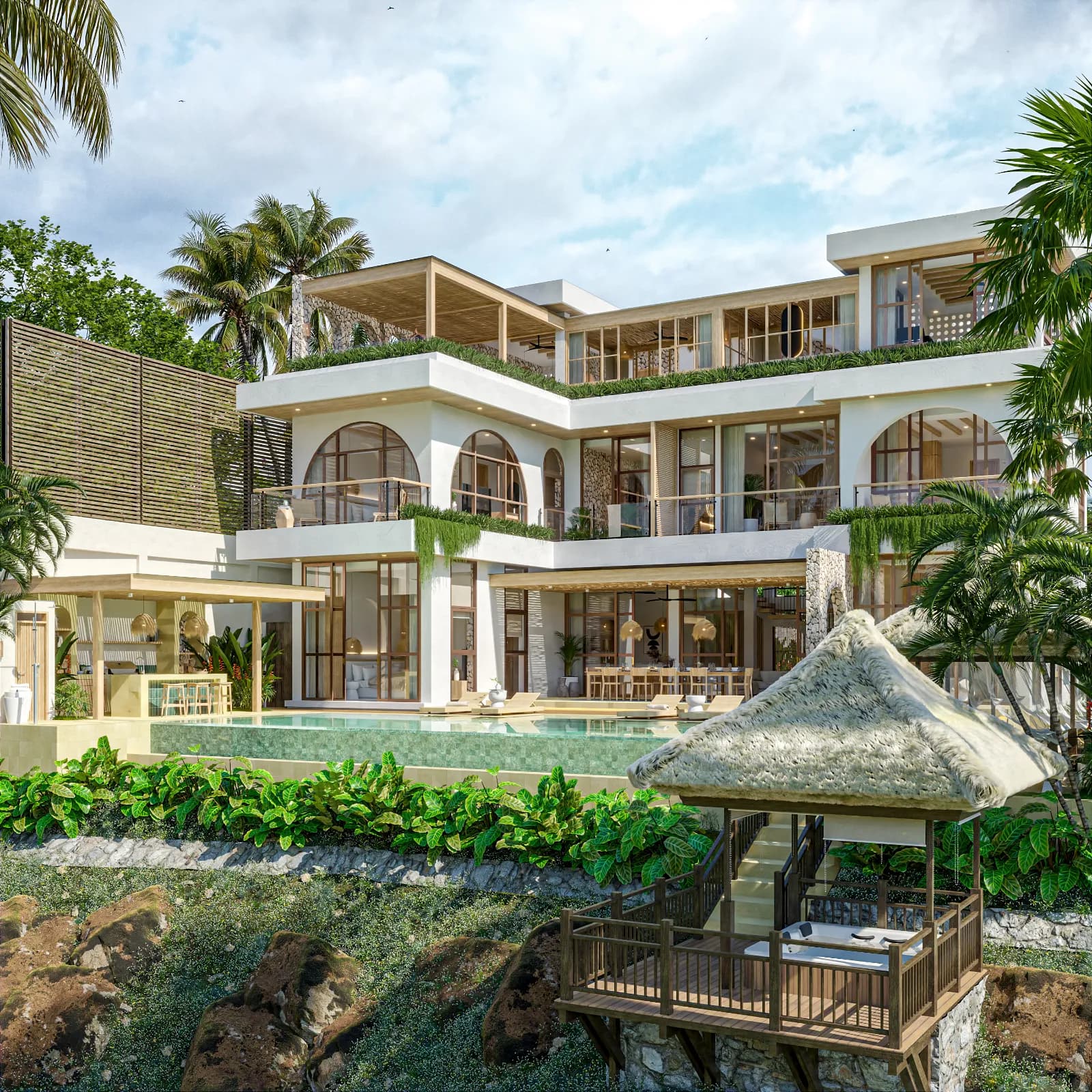
- Glass-edge infinity pool, water features
Typical Use
High-net-worth individuals building personal residences or ultra-premium rental properties targeting $500+/night. Often located in Uluwatu clifftop or prime Seminyak locations.
Real Budget Examples
Here are three representative scenarios based on actual Balitecture project data. These are construction costs only. Land, design, and additional costs are covered in the next section.
Example 1
1-Bedroom Compact Villa (100 sqm build)
Build Area
100 sqm
Spec Level
Premium
Build Cost
$120-150K
Timeline
8-10 months
Popular entry point for solo investors. Suitable for Airbnb in Canggu, Ubud, or Cemagi. Compact but well-designed, with open-plan living, private pool, and outdoor bathroom.
Example 2
2-Bedroom Investment Villa (180 sqm build)
Build Area
180 sqm
Spec Level
Premium
Build Cost
$220-300K
Timeline
10-12 months
The sweet spot for investment villas in Bali. Two bedrooms accommodate couples and small families, which is the highest-demand segment on Airbnb. This is the format used in Nara Villas (153 sqm, from $269K including land and design).
Example 3
3-Bedroom Luxury Villa (300 sqm build)
Build Area
300 sqm
Spec Level
Luxury
Build Cost
$350-500K
Timeline
12-16 months
For investors targeting the premium short-stay market ($300-600/night) or building a personal residence. Three bedrooms, multiple living areas, generous pool, fully landscaped garden. Commands top-tier nightly rates in Uluwatu, Seminyak, and Canggu.
Additional Costs Beyond Construction
Construction is typically 50-60% of the total project cost. Here's what else you need to budget for to get from bare land to a guest-ready villa.
Total Project Budget Examples
Putting it all together: land + design + construction + furniture + setup. These are realistic all-in budgets for each villa type.
1-Bed Compact Villa
$200-270KLand $30-50K + Design $10K + Build $120-150K + Pool $15K + Furniture $15-25K + Setup $5K. Total all-in budget for a turnkey 1-bedroom investment villa in a secondary location like Cemagi or Tabanan.
2-Bed Investment Villa
$340-500KLand $50-100K + Design $10-15K + Build $220-300K + Pool $20K + Furniture $20-35K + Setup $5K. The most popular format for Airbnb investors. Similar to Balitecture's Nara Villas ($269K all-in for the 2-bed).
3-Bed Luxury Villa
$550-800KLand $80-150K + Design $15-25K + Build $350-500K + Pool $30-50K + Furniture $40-60K + Landscape $15-20K + Setup $5K. Premium segment targeting high-yield rentals or personal residence. Top locations in Uluwatu, Seminyak, or Canggu.
How Does Bali Compare Internationally?
One of the most compelling reasons to build in Bali is the construction cost relative to Western markets. Here's how the numbers stack up for a comparable 200 sqm premium villa.
| Location | Cost / sqm | 200 sqm Villa | vs Bali |
|---|---|---|---|
| Bali, Indonesia | $1,200-1,500 | $240,000-300,000 | Baseline |
| Sydney, Australia | $3,500-5,000 | $700,000-1,000,000 | 5-6x more |
| London, UK | $4,000-6,000 | $800,000-1,200,000 | 6-7x more |
| Los Angeles, USA | $3,000-4,500 | $600,000-900,000 | 4-5x more |
| Melbourne, Australia | $3,000-4,500 | $600,000-900,000 | 4-5x more |
These comparisons use construction costs only, excluding land. The gap is driven by three factors: lower labour costs in Bali (skilled carpenters earn $15-25/day compared to $300-500/day for a tradesperson in Sydney), lower material costs for locally sourced stone, timber, and concrete, and no union rates or restrictive work practices.
This does not mean Bali construction is inferior. The craftsmanship, particularly in stonework, timber joinery, and thatched roofing, is among the best in Southeast Asia. What you save on labour costs, you can reinvest into higher-quality materials and finishes.
How to Prevent Cost Overruns
Cost overruns are the number one complaint from foreigners who build independently in Bali. Here's how to avoid them.
Lock your design before construction starts
Every change during construction costs 2-3 times more than if it were done in the design phase. Our architecture team produces detailed 3D renders and complete working drawings before a single foundation is poured. When you have seen the villa in 3D from every angle, there are no surprises.
Use a fixed-price contract
Cost-plus contracts (actual costs + builder margin) can spiral. Fixed-price contracts put the budget risk on the builder, which means they have an incentive to manage costs tightly. All Balitecture developments use fixed-price contracts with clearly defined scope, specifications, and payment milestones.
Choose materials early and commit
Material selection should happen during design, not during construction. Switching from local marble to imported Italian marble halfway through a build is not just expensive - it delays the schedule while new materials are sourced, shipped, and cleared through customs.
Work with a builder who handles permits
Permit delays are a hidden cost. Every week of delay means carrying costs on your land lease and potentially missing rental season targets. Balitecture manages the entire permit process as part of our construction service, because we have the local relationships and paperwork experience to keep things moving.
Build in a contingency
Even with a fixed-price contract, keep 5-10% aside for genuine extras you decide to add, like upgrading the pool surround or adding a rooftop deck. This isn't a buffer for overruns, it is a fund for intentional improvements you may want once you see the build progressing.
Fixed-Price vs Cost-Plus Contracts
This is a critical decision for anyone building in Bali, and it deserves a clear explanation.
Fixed-price: You agree on a total price upfront. The builder delivers the villa as specified for that amount. If their costs run over, that is their problem. If they come in under, they keep the difference. You get budget certainty.
Cost-plus: You pay the actual cost of materials and labour, plus a builder margin (typically 10-15%). In theory, you only pay for what is actually used. In practice, there is less incentive for the builder to control costs, and it is harder for you to verify actual costs remotely.
Our recommendation for foreign investors: always use fixed-price. The peace of mind is worth the small premium. You know exactly what the villa will cost before you start, and you can plan your investment returns with confidence. Try our Build Calculator to estimate your total project budget.